Who Created Prehistoric Rock Art and Why?

Updated: Jul 7
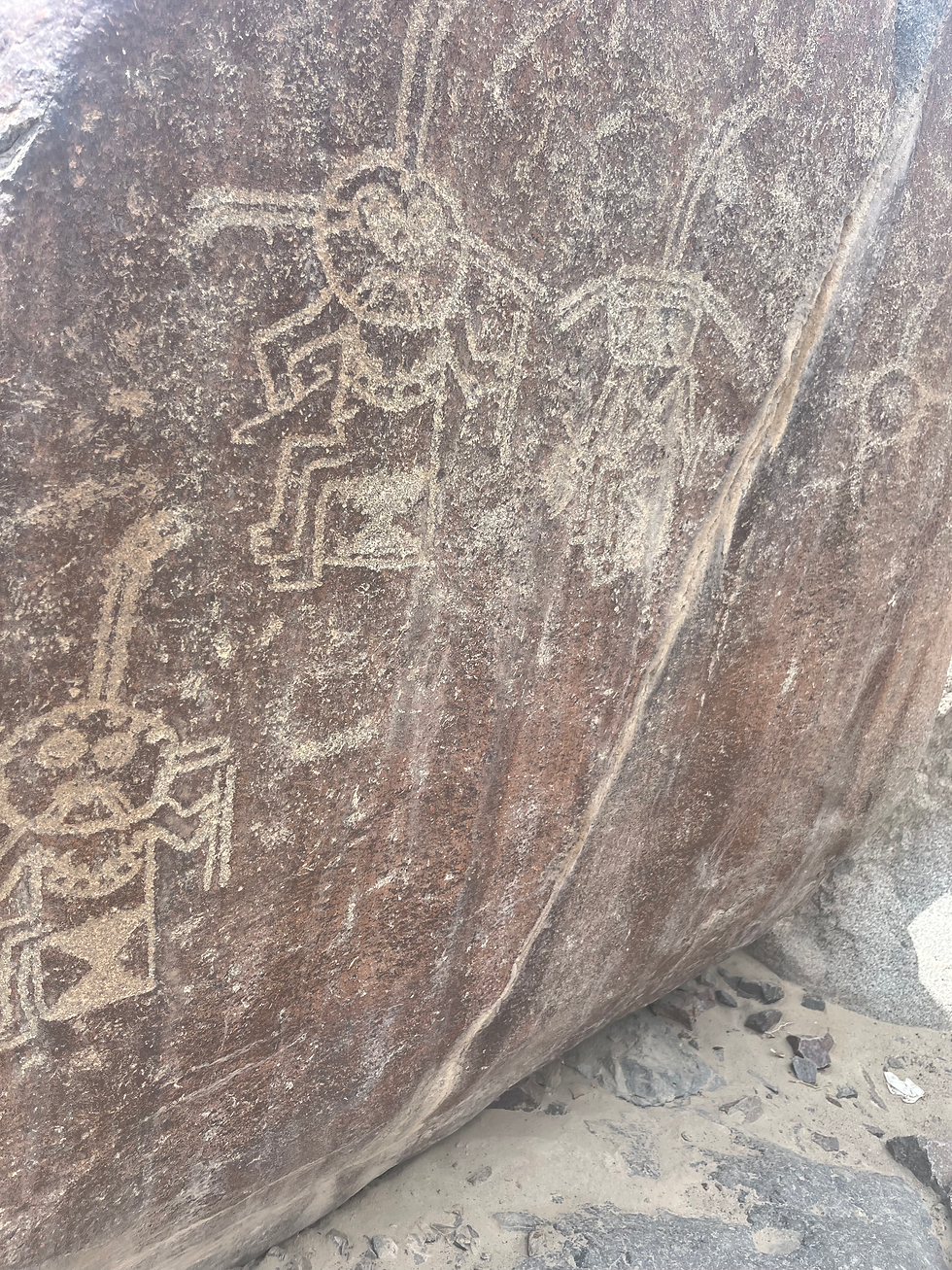
Press your palm against a cave wall where, thirty thousand years ago, someone pressed theirs. Look at the animal they painted, the symbol they carved, the handprint they left in pigment. Then ask the question that has no certain answer.
Why did you do this?
It is the most natural question in the world, and the hardest. We can see the art. We can date it, measure it, map it. We can stand exactly where the artist stood. The one thing we cannot do is ask them what it meant.
The people who made the world's rock art left no written explanation. They are separated from us by an abyss of time, by lost languages, by ways of seeing the world we can barely reconstruct. To ask who made rock art, and why, is to walk to the very edge of what we can know about the human past, then peer into the dark beyond.
Who created prehistoric rock art and why?
Quick Answer
Rock art was created by ordinary people across every inhabited continent, over tens of thousands of years, by thousands of different cultures. Most were hunters, gatherers and herders. Some images may even have been made by other human species.
As for why, there is no single answer. The leading ideas include spiritual ritual and contact with a spirit world, the recording of knowledge and stories, the marking of identity and territory, and the simple human urge to create.
Different peoples almost certainly made art for different reasons. Much of its meaning is lost to us forever. That uncertainty is not a failure of the evidence. It is part of what makes rock art so endlessly compelling.
Who actually made it?
Start with the people themselves, because even here there are surprises.
Rock art was not the work of a single culture or a special class of ancient genius. It was made by ordinary communities, the world over, across an immense stretch of time. Hunters and gatherers. Herders. Fishing peoples. The same kinds of communities that lived across the whole of human prehistory.
It was also not unique to our own species. As we have seen elsewhere, some of the oldest marks may have been left by Neanderthals, which would mean the impulse to create reaches beyond Homo sapiens entirely.
And here is a detail that quietly overturns a familiar image. When we picture a prehistoric artist, many of us imagine a man. Yet research into the hand stencils found at many sites, measuring the proportions of the fingers, suggests that a great number of them were made by women. The cave artist of popular imagination, bearded and male, may often have been someone quite different.
The makers of rock art, in other words, were everyone. Men and women. The young and the old. Whole communities, leaving their mark across the deep past.
The problem we can never escape
Before exploring why they did it, we must be honest about a limit that never goes away.
We cannot ask them.
Every theory about the meaning of rock art is an act of interpretation, built from clues rather than from any explanation the artists left behind. We study where the art appears, what it depicts, how it was made, what surrounds it. We compare it with the beliefs of living peoples. From all this we build careful arguments. None of it is the same as being told.
This is why honest scholars speak in terms of probability rather than certainty. Anyone who claims to know exactly what a prehistoric painting meant is reaching beyond the evidence. The most truthful position is humbler, and more interesting. We have powerful ideas. We do not have the final answer.
Hold that in mind as the theories unfold.
The idea that the art was hunting magic
One of the earliest explanations was also one of the most intuitive.
For much of the last century, scholars believed that prehistoric people painted animals to gain power over them. By depicting a bison or a deer, the artist might magically ensure a successful hunt, capturing the animal's spirit on the rock before capturing its body in the field. The theory was simple, vivid, easy to grasp.
It has since fallen out of favour, for a revealing reason. At many sites, the animals painted are not the animals people actually ate. In some famous caves, the inhabitants dined on reindeer while covering their walls with horses and great wild cattle. If the art were simply a charm for the hunt, the menu and the gallery ought to match. Often, they do not.
The hunting magic theory has not vanished entirely. But its decline taught the field an important lesson. The most obvious explanation is not always the right one.
The idea of the spirit world
A more influential theory looks not to the hunt but to the mind.
Drawing on the beliefs of living peoples, some scholars have argued that much rock art is spiritual, the work of ritual specialists, sometimes called shamans, who entered altered states of consciousness and recorded what they experienced there. In this view, the rock face was a kind of veil between worlds, and the art a record of journeys into the spirit realm.
Supporters point to striking patterns. The geometric shapes that appear in rock art across the world, the zigzags, dots and grids, resemble the very patterns people report seeing in deep trance. The theory also fits the testimony of certain living cultures, whose own rock art is genuinely tied to spiritual practice.
It is a powerful idea, and in some places the evidence for it is strong. It is also debated. Critics warn against stretching a single explanation across the entire planet, applying the beliefs of one people to images made by another, thousands of years and thousands of miles apart. Like every theory here, it illuminates some of the art without accounting for all of it.
The idea of identity and belonging
Other scholars look outward rather than inward, to the life of the community.
Rock art may have served to mark identity. To declare that a particular people belonged to a particular place. A great gallery of images on a prominent cliff could announce a group's presence, its history, its claim to the land around it. The art becomes a statement of who we are, and this is ours.
In this reading, certain sites functioned as gathering places, where scattered communities came together, performed ceremonies, renewed their bonds, added to the accumulating work of generations before them. The art grew over centuries, layer upon layer, a living record of a people's connection to a place.
This need not contradict the spiritual theories. A sacred gathering place and a marker of identity can be one and the same. Human meaning is rarely tidy.
The idea of recording knowledge
There is a more practical possibility, often overlooked.
Some rock art may have served to record and pass on knowledge. In societies without writing, a painted surface could hold information of real value. Which animals lived where. How a particular hunt was done. The events of a memorable season. The teachings handed to the young during initiation.
The discovery that some of the oldest art tells a story, showing figures interacting with an animal, lends weight to this idea. From very early on, it seems, people used images not only to represent the world but to narrate it. To say this happened, or this is how it is done.
Seen this way, some rock art is closer to a library than a temple. A way of keeping knowledge alive across generations, written in pictures because there was no other script to write it in.
The idea that we simply make art
Finally, the simplest possibility of all, and the one most easily forgotten.
Perhaps some rock art was made for much the same reason people have always made images. Because we are creatures who make them. Because a blank surface invites a mark. Because creating something beautiful, or capturing a living animal in pigment, is a deeply satisfying human act in its own right.
Not every image need carry a hidden meaning. Among the ritual and the record keeping, there may well have been expression, practice, even play. People delighting in their own skill. Children learning. Individuals leaving something of themselves on the rock for no grander reason than the wish to do so.
It would be a strange kind of arrogance to assume that ancient people, so like us in every measurable way, lacked the simple pleasure of making art. Some of these images may be exactly what they appear to be. The work of human beings who wanted to create.
Where we genuinely know
Amid all this uncertainty, there are precious places where we can do better than guess.
In a few parts of the world, the people who made rock art, or their direct descendants, survived into recent times, carrying living knowledge of what the art meant.
Southern Africa
The rock art of the San peoples can be partly understood through their own beliefs, recorded before that knowledge was lost. Here the spiritual interpretation rests not on speculation but on testimony, and it transforms how we read the images.
Australia
Aboriginal rock art belongs to one of the longest continuous cultural traditions on Earth. For many communities, the art is not a mystery from the past but a living part of the present, its meaning known, its making sometimes ongoing.
These cases are precious precisely because they are rare. They remind us how much meaning has been lost elsewhere, and how much richer our understanding becomes when the human voice behind the art has not fallen silent.
Why there is no single answer
Step back from the theories, and the real conclusion comes into view.
Rock art was made across the entire inhabited world, over tens of thousands of years, by countless different peoples. To expect a single explanation for all of it is like expecting a single reason behind every book ever written. The art is too vast, too varied, too human for one neat answer.
Some was surely spiritual. Some recorded knowledge. Some marked identity. Some was made for the sheer joy of making. Much of it, no doubt, was several of these things at once, in ways we will never fully untangle.
The honest answer to why people made rock art is therefore the most fascinating one. For all the reasons human beings have ever made anything. And in the silence where certainty should be, the art keeps its oldest power. The power to make us wonder.
How POV Travel approaches the question
We are not in the business of pretending to know what cannot be known.
When we take travellers to stand before ancient rock art, we share the theories honestly, the strength of each, the limits of all. We resist the temptation to deliver a tidy story, because the truth is richer than any single explanation, and the not knowing is part of the encounter.
There is something profound in standing before an image made by a person whose name, language and beliefs are lost, feeling the pull of a meaning you can sense but never quite grasp. It is humbling. It is moving. It connects you to the deep human past in a way no certainty ever could.
That is what we offer. Not easy answers, but the privilege of asking the oldest questions in the presence of the evidence itself.
Frequently Asked Questions
Who made prehistoric rock art?
Ordinary people across every inhabited continent, over tens of thousands of years. Hunters, gatherers and herders of countless cultures. Some of the oldest marks may even have been made by Neanderthals.
Did men or women make rock art?
Both. Research into hand stencils suggests many were made by women, challenging the old assumption that prehistoric artists were mostly men.
Why did ancient people create rock art?
The likely reasons include spiritual ritual, recording knowledge and stories, marking identity and territory, and the simple human urge to create. Different cultures almost certainly had different reasons.
Can we ever know what rock art really meant?
Not with certainty in most cases, since the artists left no written explanation. In a few places, such as southern Africa and Australia, living cultural knowledge gives us genuine insight.
What is the most accepted theory about rock art?
There is no single accepted answer. Spiritual interpretations are influential in many contexts, but scholars agree that rock art served many purposes across different peoples and times.
See the green Sahara for yourself
The Sahara was not always sand. The people who lived there painted the rivers, the herds and the hippos they saw with their own eyes, and their work still survives on the rock faces of Tassili n'Ajjer. To stand before it is to look at eyewitness testimony from a vanished world, and to wonder what a desert that was once green really tells us. That is the journey we take you on.
Explore the expeditions: Petroglyphs & Rock Art →
Further Reading
The Mind in the Cave by David Lewis Williams.
Bradshaw Foundation rock art archives.
UNESCO World Heritage rock art sites.
Research on prehistoric hand stencils, published in scientific journals.
Aboriginal rock art resources, Australian cultural institutions.
Continue Exploring
If this article sparked your curiosity, you may also enjoy: