How Do Scientists Date Rock Art?

Updated: Jul 7
A painting on a cave wall carries no signature. No date. No note from the artist saying when the work was done. It is simply there, on the rock, silent.
So how can anyone possibly say it is forty thousand years old? Or fifty thousand? How do you put a number on an image left by a person who vanished into the deep past without a single written word?
It sounds impossible. For a long time, it very nearly was. The dating of rock art is among the hardest challenges in all of archaeology, a problem that has defeated brilliant minds and sparked fierce arguments that rage to this day. Yet, slowly and ingeniously, science has found ways to read the age of the seemingly unreadable.
The methods are clever, imperfect and endlessly debated. Together they have built the timeline of human creativity. Understanding how they work reveals why that timeline keeps shifting beneath our feet.
How do scientists date rock art?
Quick Answer
Scientists date rock art using a combination of methods, since the art itself rarely reveals its age directly.
Radiocarbon dating can measure the age of charcoal used in some painted pigments. Uranium series dating measures the thin mineral crusts that grow over and under the art, giving minimum and maximum ages. Further clues come from the surrounding archaeology, from the style of the images, and from the animals the art depicts.
Every method has limits. Many ages are best understood as careful estimates rather than exact figures. Dating rock art remains one of archaeology's most difficult and most contested tasks.
Why dating rock art is so hard
To understand the methods, you first need to understand the problem.
With most archaeology, you can date the object itself. A piece of charcoal from a fire. A fragment of bone. A wooden tool. These carry their age within them, waiting to be read.
Rock art is different. The rock is often ancient beyond measure, formed long before any human touched it, so dating the stone tells you nothing. The image is not a separate object you can lift and test. It is a thin layer of pigment, or a shallow carving, fused to a surface far older than itself.
This is the heart of the difficulty. You cannot usually date the art directly. Instead, scientists must find something connected to it that can be dated, then reason carefully about what that age really means. It is less like reading a clock and more like detective work, building a case from fragments of evidence.
Dating the paint itself
The most direct approach is to date the pigment, when the pigment allows it.
Some ancient painters used black made from charcoal, the burnt remains of wood or bone. Charcoal contains carbon, and carbon can be dated. Through radiocarbon dating, scientists can measure how long ago that material was alive, and therefore roughly when it was burnt to make the paint.
This method has dated some of the world's most famous cave paintings, placing their charcoal images tens of thousands of years into the past. When it works, it is wonderfully direct, a date drawn from the very substance of the art.
But it carries real limits. It only works on pigments that contain carbon, which means the black charcoal paints, not the red and yellow ochres made from iron rich earth. Ochre has no carbon to measure, so a vivid red painting may be entirely undatable by this method.
There is another trap. Charcoal made from very old wood can give a date older than the painting itself, because the wood was already ancient when it was burnt. And taking a sample, however tiny, means removing a fragment of an irreplaceable artwork. Radiocarbon is powerful. It is also narrow, and not without cost.
The breakthrough: dating the crusts
The method that transformed the field does something cleverer still. It dates not the art, but the skin of rock that forms over and under it.
In many caves, water seeping through the stone leaves behind incredibly thin mineral crusts, building up across thousands of years like the layers in a stalactite. These crusts contain tiny traces of uranium, which decays at a known rate. By measuring it, scientists can date when each crust formed. The technique is called uranium series dating.
The logic is beautifully simple. If a mineral crust has grown over the top of a painting, then the painting must be older than the crust. The crust gives a minimum age. If a crust lies underneath the art, the painting must be younger than that layer, giving a maximum age. Capture both, and you bracket the art between two dates.
This is the method behind many of the oldest ages ever announced, including the discoveries that pushed the record for the world's oldest art back beyond fifty thousand years. It can reach far deeper into time than radiocarbon, which is why it has rewritten so much of the story.
It is not beyond dispute. Some of the most dramatic claims, including the suggestion that Neanderthals painted in Spain, rest on uranium series dates that other scientists question, arguing about contamination and the way these crusts form. The method is powerful. Like all the best tools, it is also fought over.
The trouble with carvings
Everything so far concerns painted art. Carvings, the petroglyphs pecked and ground into stone, present an even harder puzzle.
A carving has no pigment to sample. It is simply rock, shaped by a human hand. There is nothing organic in it to measure, nothing painted on it to date. For petroglyphs, the most direct methods fail entirely.
Scientists have tried to read the age of carvings through the dark natural coating, sometimes called desert varnish, that slowly re forms over an engraved surface once it is exposed. The idea is that a thicker or more developed coating means an older carving. In practice these methods have proven unreliable and deeply controversial, and many researchers treat their results with great caution.
This is why the ages given for petroglyphs are so often vague, expressed as broad ranges rather than firm figures. Some of humanity's most striking carved art floats in a kind of chronological fog, clearly ancient, yet stubbornly resistant to a confident date.
Reading the clues around the art
When the art itself will not give up its age, scientists turn to its surroundings.
Sometimes a painted fragment falls from a wall and is buried in the cave floor, sealed within a layer of sediment that can be dated. The art on that fragment must be older than the layer that covered it. Occupation deposits, the accumulated debris of people living in a shelter, can be dated too, hinting at when the site was in use.
In parts of Australia, scientists have used an extraordinary natural clock. Mud wasps build nests on rock surfaces, sometimes over a painting, sometimes beneath it. By dating these fossilised nests, researchers can bracket the age of the art between them, turning the humble work of an insect into a tool of archaeology.
None of these clues date the image directly. Each builds the case from the context around it, narrowing the possibilities, closing in on an answer the art will not give willingly.
Reading the clues within the art
The images themselves also hold hints, for those who know how to read them.
The subject matter can speak volumes. A painting of an animal long extinct must have been made while that animal still lived. A scene featuring an animal known to have arrived in a region at a certain time cannot be older than that arrival. We saw this in the Sahara, where the appearance of the camel in the rock art marks the late, dry chapters of the desert's story. The art carries its own internal calendar.
Style offers another guide. By comparing images, tracing how techniques and subjects changed, scholars can build sequences, ordering art from earlier to later even without exact dates. Where one image is painted directly over another, the order is plain. The lower image came first. Layer by layer, a relative chronology emerges.
These approaches rarely give a precise year. What they give is something almost as valuable. A sense of order, of sequence, of one thing following another across the deep span of time.
Why the dates keep changing
All of this explains a pattern we have met before. The dates assigned to rock art keep shifting, and the record for the oldest art keeps being broken.
Partly this is because the methods keep improving, reaching further and measuring more precisely. Partly it is because attention has spread to new regions long overlooked. And partly it is because so much rock art has never been dated at all, leaving vast room for discovery.
It is worth holding the resulting ages with appropriate care. Many are minimum ages, telling us the art is at least so old, while leaving open that it may be older. Many carry margins of uncertainty. A few rest on methods still argued over. An honest date for rock art is often a careful range, hedged with conditions, rather than a single confident number.
This is not a weakness. It is science being honest about the limits of what it knows, and remaining open to revising the story as better evidence arrives. The timeline of human art is not carved in stone. It is a work in progress, redrawn with every discovery.
How POV Travel approaches the science
We find something deeply fitting in all of this.
The dating of rock art is a perfect example of how the human past resists easy answers. The numbers we are handed, so often presented as solid fact, turn out to rest on ingenious, contested, ever improving methods. The certainty dissolves the moment you look closely, replaced by something more honest and more interesting.
When we take travellers to stand before ancient art, we share not only its age but how that age was found, and how firmly we can trust it. We treat the science with respect, including its uncertainties, because understanding how we know is part of understanding what we are looking at.
To grasp how hard it is to date these images is to see them differently. Not as fixed points on a tidy timeline, but as enigmas that still challenge our finest tools, guarding their secrets across the deep past.
Frequently Asked Questions
How do scientists date cave paintings?
Mainly through two methods. Radiocarbon dating measures charcoal in some pigments. Uranium series dating measures the thin mineral crusts that form over and under the art, giving minimum and maximum ages.
Why can't ochre paintings be radiocarbon dated?
Because radiocarbon dating needs carbon, and ochre is made from iron rich earth, which contains none. Only carbon based pigments, such as charcoal, can be dated this way.
How are petroglyphs dated?
Carvings are very hard to date, since they contain no pigment. Scientists rely on the surrounding archaeology, the style of the carvings, the animals depicted, and contested methods based on the natural coatings that form over the rock.
Why do the ages of rock art keep changing?
Because dating methods keep improving, new regions keep being studied, and most rock art remains undated. Many ages are minimum figures, open to revision as better evidence appears.
Are rock art dates reliable?
The best are well supported, but many are careful estimates rather than exact figures, and some remain debated. Honest dates are often expressed as ranges, reflecting the genuine difficulty of the task.
See the green Sahara for yourself
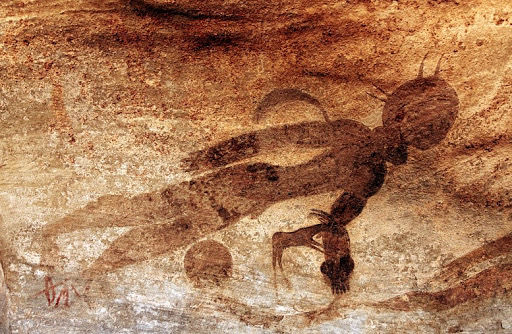
The Sahara was not always sand. The people who lived there painted the rivers, the herds and the hippos they saw with their own eyes, and their work still survives on the rock faces of Tassili n'Ajjer. To stand before it is to look at eyewitness testimony from a vanished world, and to wonder what a desert that was once green really tells us. That is the journey we take you on.
Explore the expeditions: Petroglyphs & Rock Art →
Further Reading
Research on uranium series dating of cave art, published in Nature and Science.
Bradshaw Foundation rock art archives.
Australian research on mud wasp nest dating of rock art.
The Mind in the Cave by David Lewis Williams.
International Federation of Rock Art Organisations.
Continue Exploring
If this article sparked your curiosity, you may also enjoy: