Rock Art and the Origins of Human Creativity

Updated: Jul 7
Somewhere in the deep past, a human being looked at a blank rock and saw, in their mind, an animal that was not there.
Then they made it appear.
In that moment, or rather across thousands of such moments scattered through the long dawn of our species, something extraordinary happened. A creature began to do what no creature had ever done. To take an idea from inside the mind and set it down in the world. To let a mark of pigment stand for a living beast. To imagine, and then to create.
This is the deepest story rock art has to tell. Not the tale of any single painting, but of the mind that made painting possible. The birth of human creativity itself, the moment our ancestors became, in the fullest sense, us.
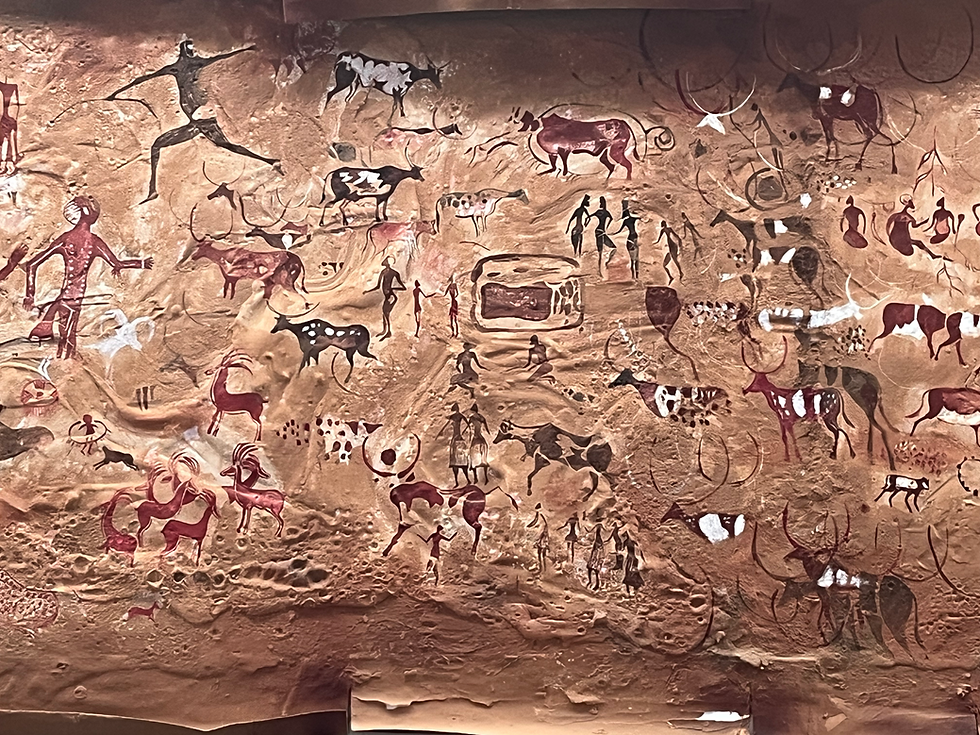
Rock art and the origins of human creativity
Quick Answer
Rock art is among the earliest surviving evidence of human creativity, and it marks one of the most important developments in our entire history. The emergence of the symbolic, imaginative mind.
To make art, a person must be able to let one thing stand for another, to picture what is not present, to share meaning with others. Rock art shows this capacity at work deep in the past.
Once thought to have appeared suddenly, the origins of human creativity are now seen as far older and more gradual, rooted in Africa long before the famous painted caves, and possibly shared with other human species.
The question beneath all rock art
We have explored what rock art looks like, how it was made, how old it is, where it survives. Beneath all of these lies a far larger question.
What does it mean that humans make art at all?
No other animal does this. Many creatures are intelligent. Some use tools, solve problems, communicate in sophisticated ways. But none paints the image of another animal on a wall. None carves a symbol whose meaning lives only in the mind. The making of art is among the things that most sharply distinguishes our species from every other.
So the existence of rock art is not merely beautiful. It is evidence. Each painted beast, each carved sign, each pressed hand is proof that the mind which made it had crossed a profound threshold, into a way of thinking that we recognise as fully, distinctively human.
To ask when rock art began is therefore to ask something much deeper. When did we become creative beings? When did the human imagination switch on?
What it takes to make art
To see why art matters so much, consider what making it actually requires of a mind.
First, symbolic thought. The ability to let one thing stand for another. A few marks of pigment are not an animal, yet the artist intends them to represent one, and others understand them the same way. This capacity to use symbols underlies not only art but language, mathematics, money, religion, everything abstract in human life.
Second, imagination. To paint an animal that is not in front of you, you must hold its image in your mind and project it onto the rock. You must picture what is absent, even what does not exist. This is the engine of all invention.
Third, shared meaning. Art is made to be seen, understood, felt by others. It assumes a community of minds able to grasp the same symbols, a culture in which meaning can be passed between people.
A creature that can do all this has a mind unlike any other on Earth. Rock art is the visible fingerprint of that mind, pressed into stone. Where we find it, we know we have found people who thought as we think.
The old story: a creative explosion
For much of the last century, the origins of human creativity were told as a sudden event.
The story went like this. Around forty thousand years ago, in Ice Age Europe, our species seemed to burst into creative life almost overnight. Painted caves appeared. Carved figurines. Personal ornaments. Elaborate burials. After a long blankness, the argument ran, the modern human mind suddenly switched on, and art came flooding into the world. Scholars called it the creative explosion, or the great leap forward.
It was a compelling narrative, built on the spectacular evidence of the European caves. For a long time it dominated how we imagined the dawn of the human spirit.
It was also, we now believe, largely wrong. Or at least, far too simple, and far too European.
The new story: deep African roots
As research spread beyond Europe, and as older evidence came to light, the picture transformed.
The flowering of art in Ice Age Europe was real. But it was not the beginning. It was a late, visible chapter in a story that began far earlier, and far to the south, in Africa.
In southern Africa, archaeologists found pieces of ochre engraved with deliberate geometric patterns, made not forty thousand years ago but closer to a hundred thousand. They found shell beads, pierced and strung as ornaments, of similar age, the oldest known jewellery. They found evidence of pigment being processed and stored with care, deep into the past.
Then came the discoveries in Indonesia, where cave paintings proved older than anything in Europe, pushing the dawn of representational art to the far side of the world. The European caves, it turned out, were not the cradle of human creativity at all. They were one branch of a tree whose roots ran much deeper.
The emerging view is not of a sudden explosion but of a long, gradual emergence. The creative mind did not switch on in an instant in Europe. It grew, slowly, across tens of thousands of years, rooted in Africa, carried across the world as our species spread. Rock art is the moment that long process becomes vividly, undeniably visible.
Before the first painting
There is a further twist. Symbolic thought may have come before representational art entirely.
The engraved ochre, the strung beads, the careful use of pigment all hint at minds already working symbolically long before anyone painted an animal on a wall. A bead worn on the body is a symbol, a statement of identity or belonging. A pattern scratched into ochre is an abstract mark with intended meaning. Deliberate burial, with the body arranged or accompanied by objects, suggests belief in something beyond the visible.
None of these is a painting. All of them reveal a mind reaching for meaning, for symbol, for significance beyond the merely practical.
This suggests that the capacity behind rock art developed gradually, in stages. First the symbolic mind itself, expressed in ornament and pigment and ritual. Then, later, its full flowering in images, the painted and carved art that lets us see ancient imagination directly. Rock art is not the birth of the creative mind. It is that mind made visible, after a long, hidden gestation.
Were we the only ones?
Now the question that unsettles everything. Was this creative spark ours alone?
For a long time the answer seemed obvious. Art was the signature of Homo sapiens, proof of our uniqueness among all the human species that have walked the Earth.
That certainty has weakened. Evidence has grown that Neanderthals, our close cousins, also used pigment, made ornaments, perhaps buried their dead with care, and possibly even made marks on cave walls. If these findings hold, and some remain debated, then the symbolic mind was not ours alone. It was older than our species, shared with at least one other kind of human.
This would mean the roots of creativity reach back beyond Homo sapiens entirely, into a shared human past we are only beginning to understand. The art on the rock might be the inheritance not of one species, but of a wider human family, each branch reaching in its own way towards meaning.
Why did it happen?
If the creative mind emerged gradually, deep in our past, what caused it? Here we reach the edge of knowledge, where honest answers give way to careful theories.
Some look to the brain, to changes in its structure or wiring that enabled symbolic thought. Some look to language, arguing that the capacity for words, themselves symbols standing for things, is bound up with the capacity for art, the two perhaps emerging together. Some look to society, suggesting that as human groups grew larger and more complex, they needed new ways to mark identity, share information, bind people together, and that symbols answered this need. Some point to sheer numbers, to growing populations in which ideas could accumulate and spread as never before.
Most likely, no single cause explains it. The creative mind probably arose from many forces working together across vast stretches of time, a slow weaving rather than a single thread.
We do not have the full answer. We may never have it. But the question, when and why our ancestors became creative, remains among the most profound that any human being can ask.
What art made possible
Whatever sparked it, the consequences were world changing.
The capacity that produced rock art produced everything else that makes us human. Language, with its endless symbols. Religion, with its imagined unseen worlds. Story, law, money, science, the great shared fictions and shared truths that allow millions of strangers to cooperate. All of it rests on the same foundation. The ability to create and exchange meaning, to let symbols stand for ideas.
Art was, in this sense, a kind of technology, perhaps the most important we ever developed. A way of storing meaning outside the individual mind, of passing it across generations, of binding a community around shared images and ideas. The animal on the cave wall and the words on this page are cousins, both expressions of the same revolutionary power.
When our ancestors began to make art, they were not merely decorating their world. They were laying the foundation of everything human that followed.
The unbroken thread
Step back, and the most moving truth of all comes into view.
The mind that made the first rock art is the same mind we carry today. The artist who painted a bison forty thousand years ago, who pressed a hand to the rock, who carved a symbol into stone, thought as we think, imagined as we imagine, felt the same urge to create that moves an artist now.
Between that distant maker and us runs an unbroken thread, the long continuous story of human creativity, never once severed across all those thousands of years. Every painting, every poem, every song, every act of human imagination since is a continuation of what those first artists began.
To stand before ancient rock art is to stand at the source of that thread, to feel it run from their hands to ours. We are not looking at the work of strangers. We are looking at the first chapter of our own story.
How POV Travel approaches this question
This, in the end, is why we travel to see rock art.
It is not only that the images are beautiful, or ancient, or rare. It is that they hold the answer, or the beginning of the answer, to the deepest question we can ask about ourselves. What are we, and how did we become this strange, creative, meaning making creature?
When we bring travellers before these images, we share both the wonder and the genuine uncertainty. The story of human creativity is being rewritten in our own time, pushed back, complicated, enriched with every discovery. We do not pretend it is finished. We invite people into the living mystery of it.
To stand before the earliest art of our species, knowing that it marks the dawn of the human imagination, is among the most profound experiences a traveller can have. It is, quite literally, to come face to face with the moment we became ourselves.
Frequently Asked Questions
When did humans start making art?
The oldest known representational art is more than fifty thousand years old, while symbolic behaviour such as engraving and ornament making in Africa reaches back around a hundred thousand years. The capacity emerged gradually over a long span.
Why is rock art important for understanding human evolution?
Because making art requires symbolic thought, imagination and shared meaning, the hallmarks of the modern human mind. Rock art is direct evidence of when our ancestors began to think as we do.
Did human creativity appear suddenly?
The old idea of a sudden creative explosion in Europe has largely given way to a view of gradual emergence, rooted much earlier in Africa and unfolding across tens of thousands of years.
Were humans the only species to make art?
Possibly not. Growing evidence suggests Neanderthals also used pigment, made ornaments and perhaps marked cave walls, implying that symbolic capacity may have been older than our species and shared with others, though this remains debated.
What does art reveal about the human mind?
That it can use symbols, imagine what is absent, and share meaning with others. These abilities underlie not only art but language, religion, science and all of human culture.
See the green Sahara for yourself
The Sahara was not always sand. The people who lived there painted the rivers, the herds and the hippos they saw with their own eyes, and their work still survives on the rock faces of Tassili n'Ajjer. To stand before it is to look at eyewitness testimony from a vanished world, and to wonder what a desert that was once green really tells us. That is the journey we take you on.
Explore the expeditions: Petroglyphs & Rock Art →
Further Reading
The Mind in the Cave by David Lewis Williams.
The First Signs by Genevieve von Petzinger.
Research on early symbolic behaviour at Blombos Cave.
Sapiens by Yuval Noah Harari.
Natural History Museum resources on human origins.
Continue Exploring
If this article sparked your curiosity, you may also enjoy: