What Is a Pygmy Whale?

In 1938, a museum curator in South Africa looked into a fishing boat's catch and saw a fish that had been extinct for sixty six million years.
The coelacanth was not rare. It was not endangered. It was finished, gone, a creature known only from stone, filed away in the fossil record alongside the dinosaurs it had supposedly died with. And there it lay on the deck, wet, heavy, blue, entirely alive, having spent the whole of recorded human history swimming quietly beneath us while the textbooks pronounced it dead.
Nobody had been looking. That was the only reason.
We tell you this before we tell you about the pygmy right whale, because you need to understand what the word extinct actually means in practice. It does not mean gone. It means we have not found one lately. And somewhere in the cold water circling the bottom of the world swims a six metre whale that almost no living person has ever seen, which may belong to a family of whales that everyone agrees died out millions of years ago.
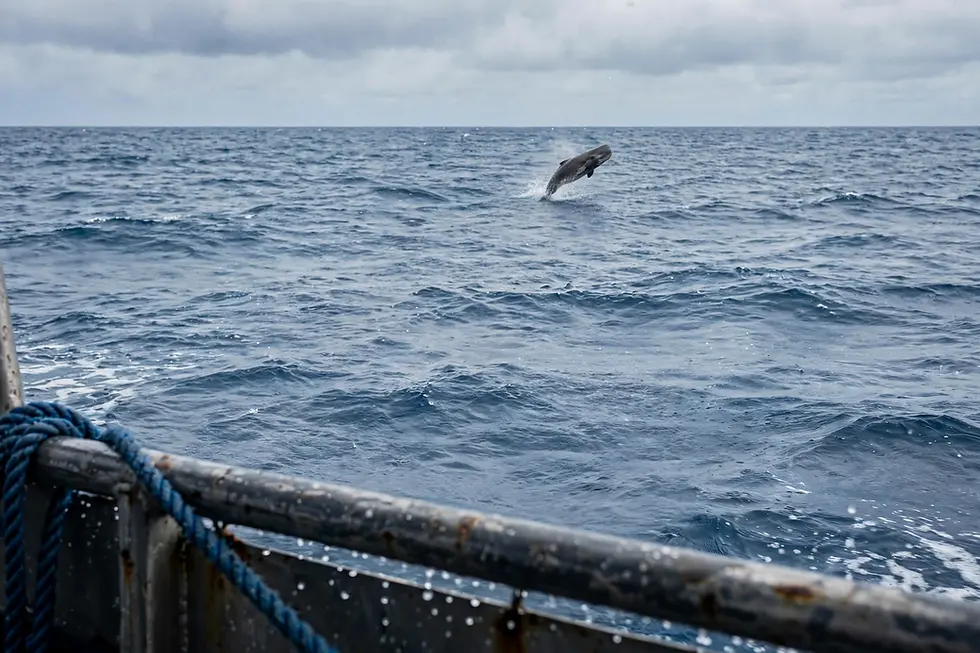
What is a pygmy whale?
Quick Answer
The pygmy right whale is the smallest baleen whale in the world, around six metres long, living in the cold waters of the Southern Hemisphere.
It is one of the least observed large animals on the planet. Confirmed live sightings are extremely rare. Almost everything known about it comes from dead animals washed ashore. Nobody can tell you how many exist, because nobody has counted, because nobody can find them.
Several researchers have argued, on anatomical and genetic grounds, that it is the last living member of the cetotheres, a whale family believed extinct for millions of years. Others disagree. The question is genuinely open, which is a great deal more interesting than an answer.
An animal that should be easy to find
Consider the reasons this ought to be a solved problem.
The pygmy right whale is not microscopic. It is roughly the length of a small bus. It is a mammal, which means it must come to the surface and breathe, repeatedly, forever, in the open air, where we could see it if we were there.
We have mapped the sea floor from orbit. We have tagged white sharks and followed them across oceans. We have photographed animals living in the crushing dark seven kilometres down. We are told, routinely, that the age of discovery is behind us and that the natural world has been catalogued.
And yet almost nobody has ever watched this animal alive. Most of what we know has been reconstructed from corpses, stranded on beaches in Australia, New Zealand, South Africa, South America. Museums hold its bones. Scientists study its tissue. Its behaviour is close to a blank page.
We would like you to sit with that, because it is not a curiosity. It is a measurement of our ignorance, and it is very large.
Why nobody finds it
The honest answer is that we do not fully know, though the pieces make sense.
Its range appears to span the enormous, stormy, largely unobserved belt of ocean that circles the Southern Hemisphere, far from shipping lanes and research vessels. It seems to travel alone or in small groups rather than in the conspicuous gatherings that make other whales findable. It does not breach theatrically. It does not blow a tall visible spout. It surfaces briefly, quietly, and is gone.
In other words, this animal is not hiding from us. It is simply living somewhere we do not go, in a manner that does not attract attention, in a sea vast enough to lose a bus in.
It has never been commercially hunted in any serious way, which means the whaling fleets that mapped the distribution of every other large whale by killing them never bothered to map this one. Our knowledge of great whales is, to an uncomfortable degree, a byproduct of having slaughtered them. The species we spared, we do not know.
The claim that ought to stop you
Now to the part that we think deserves far more attention than it receives.
For a long time this animal was filed as an oddity, a small strange cousin of the right whales. Then researchers looked hard at its skeleton and at its genes, and the picture that came back did not fit.
Its skull is wrong for a right whale. Its ribs are wrong. Its whole architecture sits awkwardly in the family it is named after. What it does resemble, closely, is a group of ancient whales called cetotheres, which flourished millions of years ago and then, according to the fossil record and every textbook built on it, vanished completely.
Several published studies have argued that the pygmy right whale is a cetothere. Not a distant relative of the family. The last one. A single surviving branch of a dynasty that palaeontology declared dead long before our species existed.
Other researchers dispute this and place the animal elsewhere on the whale family tree. The argument runs on in the journals and it has not been settled.
We are not going to settle it for you either. We are going to point out that the disagreement is about whether there is a living fossil, a genuine survivor of deep time, breathing air off the coast of Australia right now, and that the reason we cannot resolve it is that nobody can find enough of them to study.
What extinct really means
Here is the thought that we think matters more than the whale.
The fossil record is not a census of the dead. It is a scatter of accidents. To become a fossil, an animal must die in the right place, be buried fast enough, in sediment of the right chemistry, then survive tens of millions of years of geological violence, then be lifted back to the surface, then be found by one of the very small number of human beings who look for such things.
The overwhelming majority of species that have ever lived left no trace at all. Of those that did, we have found a fraction. From that fraction we build confident statements about what existed and when it ended.
So when a textbook says a family of whales went extinct several million years ago, what it means, precisely, is this: we have not found a younger fossil of one, and we have not found a living one, and we have not looked in most of the ocean.
The coelacanth taught us this lesson in 1938 and we appear to have forgotten it. The pygmy right whale may be about to teach it again, and this time we will have known the animal was there the whole while and simply failed to look properly.
The other pygmy whale
A brief clarification, because two very different creatures share the nickname.
The pygmy sperm whale is a toothed whale, related to the great sperm whale, hunting squid in deep water rather than filtering plankton. It is also rarely seen, also poorly understood, also known mostly from strandings. When threatened it releases a cloud of dark intestinal fluid into the water, rather as a squid does, and disappears behind the murk.
Two reasonably large marine mammals, both barely observed, both living where we do not look. If the phrase pygmy whale reaches you, it may mean either. Both should make us humble.
Why the ignorance matters
It is tempting to file all of this under charming trivia. We would ask you to resist that.
You cannot protect what you cannot count. There is no confident population figure for the pygmy right whale. Nobody knows whether it is stable, increasing, or quietly disappearing. If something began to go wrong, through changes in the krill and copepods it eats, through warming southern water, through plastic or noise or entanglement, we would probably not notice until it was well advanced. Conservation depends on knowing, and here we do not know anything at all.
And consider what would be lost. If the cetothere argument holds, then this animal is the last living thread connecting our world to an entire family of whales that swam these oceans for millions of years. To lose it would not be to lose a species. It would be to sever a lineage that survived every catastrophe the planet could produce, and to do it in our own century, having barely established that it was there.
That is a strange kind of failure. Not a slaughter. Simply an absence of attention.
The creature that does not fit the story
Everything we look for at POV Travel sits in this animal.
It is a baleen whale barely bigger than a boat. It carries the name of a family it may not belong to. It may be the sole heir of a dynasty that palaeontology buried. And it lives, unstudied and uncounted, in an ocean we have been assured is thoroughly known.
Every fact about it dismantles a comfortable assumption. That big animals have been found. That the fossil record is a reliable ledger. That discovery is finished. Here is a whale saying otherwise, in cold water, where nobody is watching.
How POV Travel sees the pygmy whale
We are going to be honest with you, because wonder is worth nothing if you cannot trust the person offering it.
We cannot take you to see a pygmy right whale. Nobody can. The animal is too scattered and too little understood, and any operator who promises you a sighting of it is selling something they cannot deliver. Be extremely careful with anyone who guarantees you a rare animal.
What we can do is take you into the ocean where creatures like this exist, on expeditions built around the marine life that can genuinely be found, and tell you the truth about what else is out there. In the water with Big Blue Snorkel, among sharks and whales and the great feeding events of the South African coast, we talk about this whale. Because knowing it is there changes the water.
The sea beneath you stops being an inventory and becomes a frontier. Somewhere out there swims an animal that may be older, in the deepest sense, than anything else with baleen in its mouth, and it has kept that secret through two centuries of scientific attention.
We question. We teach. We leave you with an opinion of your own.
So here is the question we would leave you holding, floating in the blue with your face in the water. If a six metre air breathing mammal can go this thoroughly unseen, what exactly do we think we know about what is down there?
Frequently Asked Questions
What is a pygmy whale?
Usually the pygmy right whale, the smallest baleen whale at around six metres, found in cold Southern Hemisphere waters. The name is sometimes also used for the unrelated pygmy sperm whale, a small toothed whale.
Why is it so rarely seen?
It lives across a vast, stormy, poorly monitored ocean, travels alone or in small groups, and behaves inconspicuously at the surface. Most of what we know comes from animals washed ashore dead.
Is it a living fossil?
Possibly. Several researchers have identified it as the last surviving cetothere, an ancient whale family believed extinct for millions of years. Others dispute this. The question remains genuinely unresolved.
How many pygmy right whales are there?
Nobody knows. There is no reliable population estimate, which makes assessing its conservation status close to impossible.
Can you see one on a whale watching trip?
Realistically no. Confirmed live sightings are extremely rare. Any operator guaranteeing an encounter with this animal is not being straight with you.
Meet the ocean for yourself
You can read about the creatures that hide in the blue, or you can get into it. Drift among oceanic blacktip sharks in the warm currents of Aliwal Shoal, or hang in the open water off Cabo San Lucas as a mako, the fastest shark in the ocean, cuts past you and is gone. No cage, no bait, no adrenaline theatre. Just the animals as they truly are, met on their terms, in small groups, with people who understand them.
Explore the expeditions: Swim With Sharks & Marine Life →
Further Reading
Research on the phylogenetic position of the pygmy right whale.
Studies of cetothere fossils and their relationship to modern baleen whales.
International Union for Conservation of Nature assessment of Caperea marginata.
Museum and stranding network records of Southern Hemisphere cetaceans.
Scientific literature on the pygmy sperm whale and other little known cetaceans.
Continue Exploring
If this article sparked your curiosity, you may also enjoy: